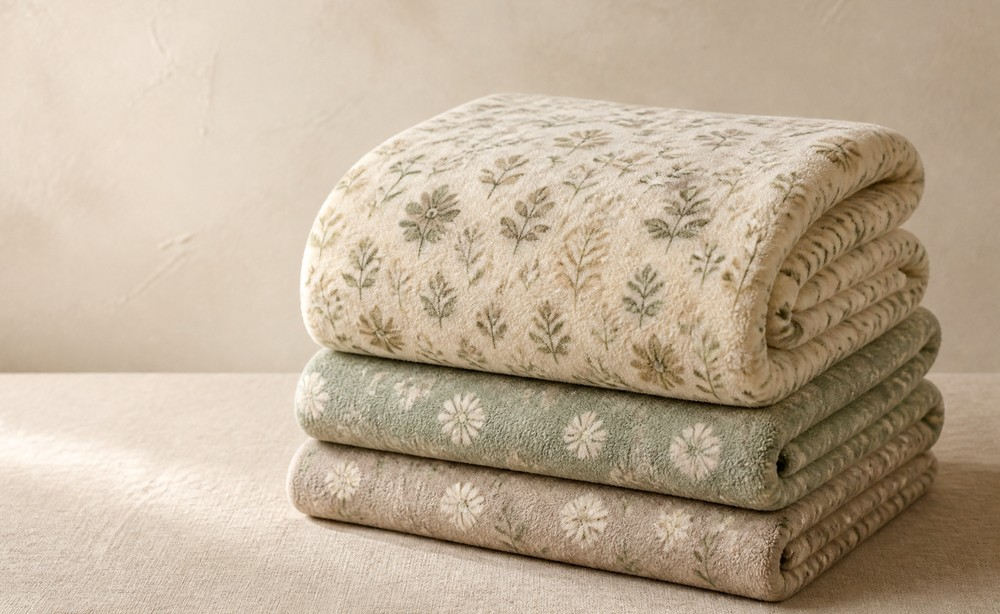
A floral print blanket in three colourways, folded for retail. The artwork has to be separated for pile, not for paper.
A floral print blanket is the easiest product to approve on a mood board and one of the harder ones to reproduce at volume. The reason is structural: the print has to sit on a raised, compressible surface, and pile does not accept ink the way flat woven cotton does. Buyers who treat a printed throw like a printed T-shirt usually discover the gap at the pre-production sample, three weeks before their season ships.
This guide covers what actually determines whether a floral blanket looks right, wears well and prices out.
Choose the ground fabric before the flower
Pile height sets everything downstream — print sharpness, hand feel, and how the blanket survives washing.
- Flannel fleece, 220–280 g/m². The volume product. Prints hold well, edges can be bound or overlocked, and unit cost stays low.
- Velboa / “mink” plush, 260–320 g/m². Softer, denser, more premium in hand. Fine linework softens, so floral artwork needs heavier outlines and fewer hairline details.
- Cotton muslin, 4-ply. The infant and summer blanket route. Prints are softer and slightly faded by design; expect more shrinkage and specify pre-shrinking.
- Sherpa reverse. Print on the smooth face, sherpa on the back. Watch for shade mismatch between the two sides under retail lighting.
A useful rule: the bushier the pile, the simpler the artwork. Ask for a strike-off on the actual ground fabric, never on paper or on a flat cotton substitute.

Ink on brushed pile at macro scale: the flower edges soften into the fibres, which is why hairline linework disappears on 300 g/m² plush.
Three print routes, three different economics
Rotary screen printing is the cheapest per unit at volume and gives dense, opaque colour on dark grounds. The trade-off is setup: each colour needs its own screen, so an eight-colour floral carries eight setup charges and a long run to amortise them. Gradients and photographic shading are effectively impossible.
Digital reactive printing removes the colour-count penalty. A 12-colour watercolour floral costs the same to set up as a two-colour one, and short runs become viable. Per-metre cost is higher, colour depth on deep navy or black grounds is weaker, and production speed is slower.
Sublimation prints polyester only, but handles photographic florals and full-bleed gradients better than anything else. It dyes the fibre rather than coating it, so the print does not crack — but it cannot be used on cotton, and the hand feel is distinctly synthetic.
Match the route to the order, not to the sample: a 300-piece trial and a 30,000-piece programme call for different answers.
Repeat maths decides whether it looks designed
Most blanket widths land between 150 and 200 cm. A floral repeat of 32 cm gives roughly five repeats across the width — dense enough to read as a pattern, large enough that individual blooms stay legible. Drop to 15 cm and it reads as wallpaper.
Two details separate amateur from professional artwork:
- Half-drop versus straight repeat. Half-drop hides the grid. Straight repeats on large florals produce visible vertical lanes.
- Motif placement at the fold line. When the blanket is folded for retail, the centre panel is what the customer sees. Specify that the hero bloom lands within 10 cm of centre, or you will get a fold that cuts a flower in half on every unit.
Also confirm repeat direction against the pile direction. A print that runs correct on the roll can appear brushed-flat on a cut-and-sew panel if the cutter ignores nap orientation.
Colourfastness: the three tests that matter
Floral prints fail in the wash more often than they fail in the design. Request these before approving bulk:
- AATCC 61 (3A) for accelerated laundering — a minimum of grade 4 for shade change on mid and dark grounds.
- AATCC 8 for wet crocking. Light petals on a dark ground are the classic bleed case; below grade 3–4, expect pink-tinted whites after two washes.
- AATCC 16 for lightfastness if the blanket will sit in a window display or ship to high-UV markets.
Ask for the report with the batch number printed on it; a report without dye-lot traceability is decoration.
The QC points that predict reorder rate
Print registration within ±2 mm across the seam; residual shrinkage under 3% after one wash; pile shedding checked by tape-lift; bound edge width consistent within 2 mm; and a packed-count check, because blanket cartons are frequently short by one or two pieces.
Timing is the other constraint. Print strike-offs take 7–10 days, a pre-production sample another 10–14, and bulk 25–35 days after approval. Working backwards from a retail launch, artwork needs to be locked roughly 90 days out — which is why floral programmes are specified in the off-season, not in the month the buyer wants them.
ЧАСТО ЗАДАВАЕМЫЕ ВОПРОСЫ
What is the minimum order for a custom floral print blanket? Digital print starts far lower than rotary, because there are no screens to amortise. Ask whether the MOQ applies per design or per colourway — many quotes hide a second minimum behind each variant.
Can I use the same artwork across fleece and muslin? Only after re-separating it. Muslin’s looser weave and higher shrinkage will soften fine lines and shift registration.
How many colours should a floral print use? On rotary, six to eight is the practical ceiling before setup cost dominates. On digital, colour count is irrelevant — file size and gradient complexity drive cost instead.