How often you should replace pillows depends on how often they are washed, not on how they look. In a hotel running a normal laundry cycle, a polyester-cluster pillow is finished somewhere between 12 and 18 months; a memory foam pillow lasts 24 to 36 months; a well-made down pillow can hold three years if it is dried properly. At home those numbers roughly double, because the pillow sees a fraction of the wash cycles.
The reason the question matters commercially is that a collapsed pillow does not fail loudly. It still has a clean cover, it still goes through the laundry, and it still looks acceptable on a made bed. What has gone is loft, and loft is the entire product. A guest sleeping on a 4 cm pillow in a room sold as four-star is a review waiting to happen, and no amount of thread count on the taie d'oreiller fixes it.

Why hotel pillows fail faster than home pillows
A domestic pillow is washed perhaps twice a year. A hotel pillow in a property with a proper protect program is washed two to six times a year, and it sits under a protector that is changed and laundered between every guest. The pillow itself takes far fewer wash cycles than the sheets, but it spends its life compressed under a head for eight hours a night, fifty-two weeks a year, and that compression is what kills the fill.
Two mechanisms do the damage. The first is fiber fatigue: polyester cluster fill is crimped to trap air, and each wash and tumble cycle relaxes the crimp a little further until the cluster stops springing back. The second is moisture history. A pillow that goes into a store room slightly damp, or that is dried at low heat because the laundry is running behind, develops a compressed core that never recovers. Hotels rarely notice either process because the change is gradual and the housekeeping standard is visual.
The practical consequence is that replacement cycles in hotels are set by wash count and drying discipline, not by the calendar and certainly not by visible staining. A property that dries pillows properly gets 18 months out of the same SKU that a property with a cold, rushed dryer writes off in twelve.
The replacement interval by fill type
There is no single answer to how often you should replace pillows, because fill type changes the curve. The table below is the working range we quote for contract buyers in a property with commercial laundry; treat it as a planning assumption to be tested against your own wash log, not a warranty.
| Fill | Hotel replacement interval | Home replacement interval | Failure signature |
|---|---|---|---|
| Polyester cluster | 12–18 months | 24–36 months | Loft collapses to a flat pad; fill migrates to the ends |
| Siliconized hollow fiber | 18–24 months | 3–4 years | Gradual flattening, better recovery after wash |
| Memory foam shred | 24–36 months | 3–5 years | Shreds compress into a hard core; no recovery |
| Solid memory foam | 24–36 months | 3–5 years | Surface softening, then a permanent body impression |
| Down / feather | 24–36 months | 5+ years | Quill poke-through, clumping, loss of fill volume |
| Microfibre | 12–18 months | 2–3 years | Dense, heavy, no rebound |
Two patterns are worth pointing out. Cheaper fills do not fail faster in a straight line — they fail abruptly, holding shape until the crimp gives out and then flattening within a couple of months. And the interval shortens in properties with high occupancy: a room sold 85% of the year compresses its pillows roughly twice as many nights as one sold 45%, so the same SKU can legitimately run 18 months in one building and 30 in another.
The four signs a pillow is finished
Visual inspection is the weakest test available, which is why so many hotels replace late. The checks that actually predict failure are physical, and housekeeping can run them in seconds during a room refresh.
The fold test. Fold the pillow in half and release it. A serviceable pillow springs back to shape within a few seconds. One that stays folded has lost its rebound and will flatten again the first night.
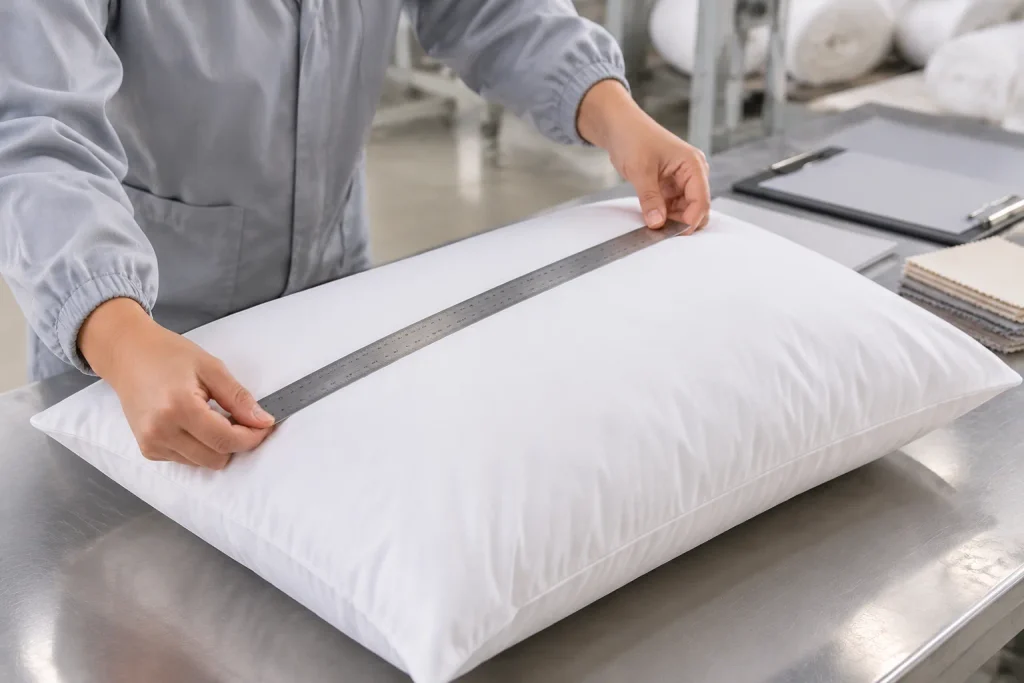
Loft measurement. Lay the pillow flat and measure the center height with a ruler at the same point every time. A new 700 g cluster pillow typically sits at 12–14 cm; once it drops below 8 cm it no longer supports a neck. Recording that number per floor is more reliable than any opinion about feel.
Weight and moisture. A pillow that has gained noticeable weight is holding moisture and dust in the core, and no amount of washing will bring the loft back. Smell the center seam, not the surface.
Cover integrity. A stained or split inner cover means the fill has been exposed to body fluids, and the pillow should go regardless of loft. This is also why a washable pillow protector pays for itself: it moves the staining to a cheap item that is designed to be replaced.
Calculating the replacement rate and the annual budget
Replacement planning is arithmetic once you accept a service life. For each pillow position, divide twelve by the service life in months to get an annual replacement rate, then multiply by the number of positions.
A 120-room property with two pillows per bed, a spare set in the store, and an 18-month polyester cycle needs 120 × 2 × (12 ÷ 18) ≈ 160 pillows a year, plus roughly 10% for breakage and staining. At a contract price of $6–$9 per pillow that is $1,000–$1,450 a year, or about $2.50 per room per month. The number is small. The cost of not spending it is a floor full of flat pillows and the reviews that follow.
The budget conversation changes when you model it per room-night instead of per unit. Replacing all 240 pillows in one hit looks like a $2,000 expense and gets deferred; replacing 40 per quarter at $330 looks like housekeeping consumables and gets approved. Same annual spend, completely different approval path. Properties that budget pillows as a linen line item rather than a capital purchase stay on cycle; properties that treat them as furniture buy them in panic batches every four years.
Staggered replacement versus full-floor replacement
Full-floor replacement is tidier on paper and worse in practice. Every pillow on the floor reaches the end of its life at the same moment, which means a single large order, a single delivery to store, and a floor that feels different overnight — guests notice a change in pillow height more than they notice a gradual improvement.
Staggered replacement spreads the same spend across quarters and keeps a rotation going: buy one quarter’s worth, move the oldest stock to the lowest-tier rooms, retire the worst. The operational benefit is that you always have a known-good reference pillow in the building to compare against, which makes the loft test meaningful instead of subjective. The procurement benefit is that you can reorder the same specification four times a year and catch drift early — a supplier who quietly drops fill weight from 700 g to 650 g is far easier to catch on a quarterly delivery than on a four-yearly one.
The exception is a new opening or a full refurbishment, where a single batch makes sense because there is no existing stock to rotate and the brand standard has to be set in one go. In that case order 5–10% extra as attic stock and start the rotation immediately.
How pillow specification changes the cycle
If the replacement interval is the problem, specification is the cheapest lever. Three values move the number more than anything else on the spec sheet.
Fill weight. A 700 g cluster pillow holds loft measurably longer than a 550 g one, because there is more material to fatigue. This is the single most common place where a cheap quote wins a tender and loses money for three years.
Fill type. Siliconized hollow fiber recovers after washing in a way that standard cluster fill does not. The cost difference is small; the service life difference is 6–12 months.
Inner cover construction. A tightly woven, down-proof inner cover keeps the fill in place and stops quill or fiber migration. A loose cover lets fill shift to the ends, which reads as a collapsed center long before the fill has actually failed.
Specify all three in grams and construction terms, not in words like “premium” or “hotel quality”. A supplier quoting against a written specification with fill weight, cover thread count and wash temperature is quoting the same product you will receive; a supplier quoting against “hotel pillow” is quoting whatever is in the warehouse that week.
Reordering without drift
The failure mode after the first successful order is drift. The second delivery is 20 g lighter, the cover is a slightly different weave, the loft is 1 cm shallower — each difference is inside tolerance, and together they move the product into a lower tier.
The fix is a retained reference sample. Keep two pillows from the approved batch sealed and labeled with the order number, the fill weight and the measured loft. Every subsequent delivery is compared against them physically, not against a description. Add the loft measurement to the goods-in checklist for housekeeping, and require the supplier to state fill weight on the packing list for each carton.
For properties running multiple brands under one roof, keep one reference per tier. A three-star pillow and a five-star pillow are different products with different service lives, and using one as the benchmark for the other hides exactly the drift you are trying to catch.
FAQ
How often should you replace pillows in a hotel? Every 12–18 months for polyester fill, 18–24 months for siliconized hollow fiber, and 24–36 months for memory foam or down, assuming commercial laundry at normal temperatures. Properties running high occupancy or aggressive drying should plan at the short end of each range.
How often should you replace pillows at home? Roughly double the hotel interval: two to three years for polyester, three to five years for memory foam, and five years or more for a good down pillow that is washed and dried properly.
Can a pillow be washed to extend its life? Washing removes soil and odor, but it also accelerates the fiber fatigue that flattens a pillow. A wash every three to six months is reasonable; washing monthly will shorten the service life rather than extend it.
Do pillow protectors make pillows last longer? Yes, and they are the cheapest intervention available. A protector takes the staining, the sweat and most of the abrasion, and it can be replaced at a fraction of the cost of the pillow.
How many spare pillows should a hotel keep? Plan for 10% attic stock on top of the working floor, plus one replacement set for the room types that turn over fastest. Below 5% you will be buying at short notice and paying retail-adjacent prices.
Specifying the next order
If the current floor is due, the fastest route is to take one pillow from each tier, measure fill weight and loft, and send those two numbers with the room count and laundry temperature. That is enough to quote against, and it is also enough to catch the most common quoting error, which is a supplier answering with a catalogue number instead of a specification.
Add three things to make the quote comparable across suppliers. State the replacement interval you are planning to, so the fill weight can be judged against the service life rather than the price. State the wash temperature and drying method, because a supplier quoting for 60 °C line drying and a supplier quoting for 80 °C tumble drying are quoting different products at the same unit price. And state the tier structure — how many rooms at each star level — so the quotation comes back split by tier instead of as one blended number that hides the drift between them.
For a property that is replacing in phases, ask for the first phase priced alone and the full annual quantity priced separately. The difference between those two numbers is your real volume discount, and it is worth knowing before you commit to a three-year agreement.
The same specification discipline applies to the wider bedding range that sits on the same purchase order — duvet inserts, protectors, linge de lit d'hôtel sets — and buying them together keeps the tiers consistent across the room. A five-star pillow paired with a three-star duvet is a specification error that guests notice immediately, even if they cannot name it.
Start from the pillow and cushion range to match fill and firmness, then send the per-tier counts and the planned replacement interval for a costed replacement plan.