Wholesale beach towels are bought on three numbers and one decision. The numbers are GSM, finished size and pile type. The decision is how the design gets onto the towel, because that choice determines the minimum order, the lead time and whether the artwork still looks right after a season beside a chlorinated pool.
Buyers who get this wrong usually do it in the sample stage: they approve a heavy, beautifully printed sample, then discover the print method needs a 3,000-piece minimum, or that the towel weighs enough to double the freight on a resort order. This guide sets out the specification in the order a purchase decision actually happens.
Why wholesale beach towels are not just large bath towels
A bath towel is built for absorbency and repeated laundering at 60 °C. A beach towel is built for surface area, colour retention and the fact that it will be sat on, dragged across sand and washed far less often than it is used.
That changes the construction. Beach towels run larger and often lighter per square metre than a hotel bath towel, because a 90 × 170 cm towel at hotel bath weight is heavy to carry and expensive to ship. They also carry a design — a woven jacquard band, a printed panel or an all-over print — which a bath towel rarely does.
For a resort, the beach towel is also a branding item and an inventory item that disappears. Towel loss on a pool deck runs at a rate that no other linen category matches, so replacement volume, not unit price, is the number that drives the annual budget.
GSM, size and weight: the three numbers on the purchase order
GSM (grams per square metre) is the density of the pile. Beach and pool towels typically sit in the 400–600 GSM range. Under 400 feels thin and stops absorbing after a few uses; above 600 is plush but slow to dry, heavy to ship and slow in a commercial dryer. For resort pool use, 450–550 GSM is the practical band; for retail and promotional towels, 400–450 keeps the landed cost down and the pack compact. Buyers ordering wholesale beach towels for the first time tend to over-specify GSM, and then discover the laundry cannot dry the volume.
Finished size drives both the guest experience and the freight. Common formats:
| Utilice | Size (cm) | Notes |
|---|---|---|
| Pool towel | 70 × 140 | Standard resort pool deck |
| Beach towel | 80 × 160 | The most common retail and resort format |
| Large beach | 90 × 170 | Premium resorts, cruise lines |
| Cabana / lounger | 100 × 180 | Custom for cabana and daybed layouts |
| Kids / promotional | 60 × 120 | Low unit cost, high print coverage |
Weight per piece is the number that appears on the freight invoice. A 90 × 170 cm towel at 550 GSM weighs roughly 840 g before packing; 500 pieces is over 400 kg of product, and carton volume decides the container cost. Always ask for the packed carton dimensions and units per carton alongside the unit price.
One more specification worth writing down: tolerance. A “500 GSM” towel that arrives at 460 GSM is not a rounding error, it is a 8% cost saving taken by the factory. Set a tolerance, typically ±5%, and check it on the first shipment by weighing a towel and dividing by its area.
Jacquard, velour or print: choosing the branding method
The design method determines minimum order, durability and cost, and each one suits a different buyer.
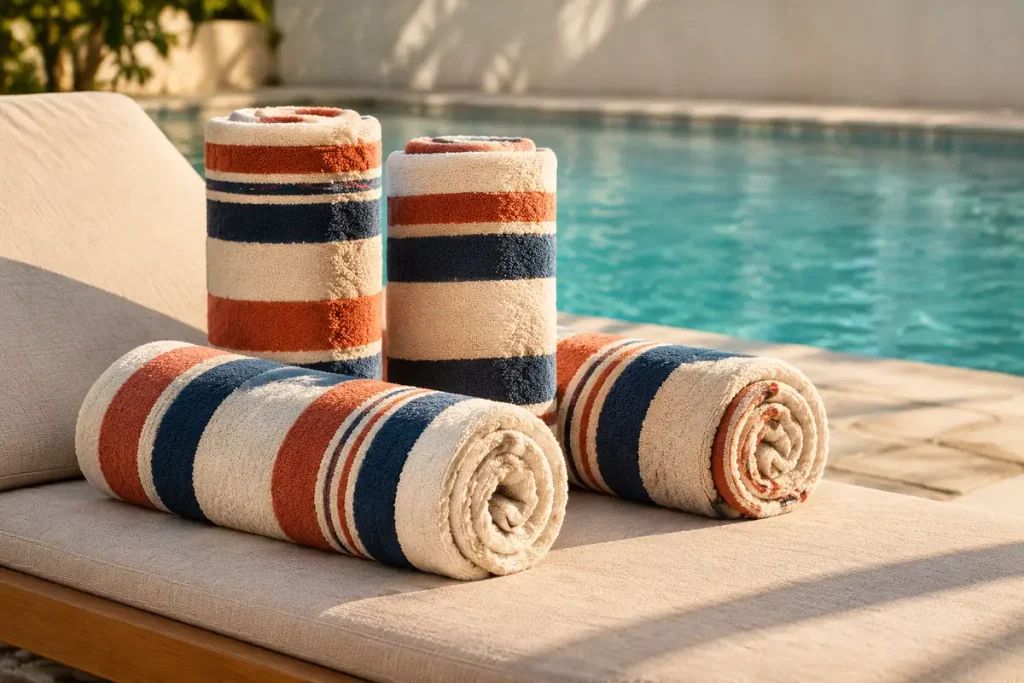
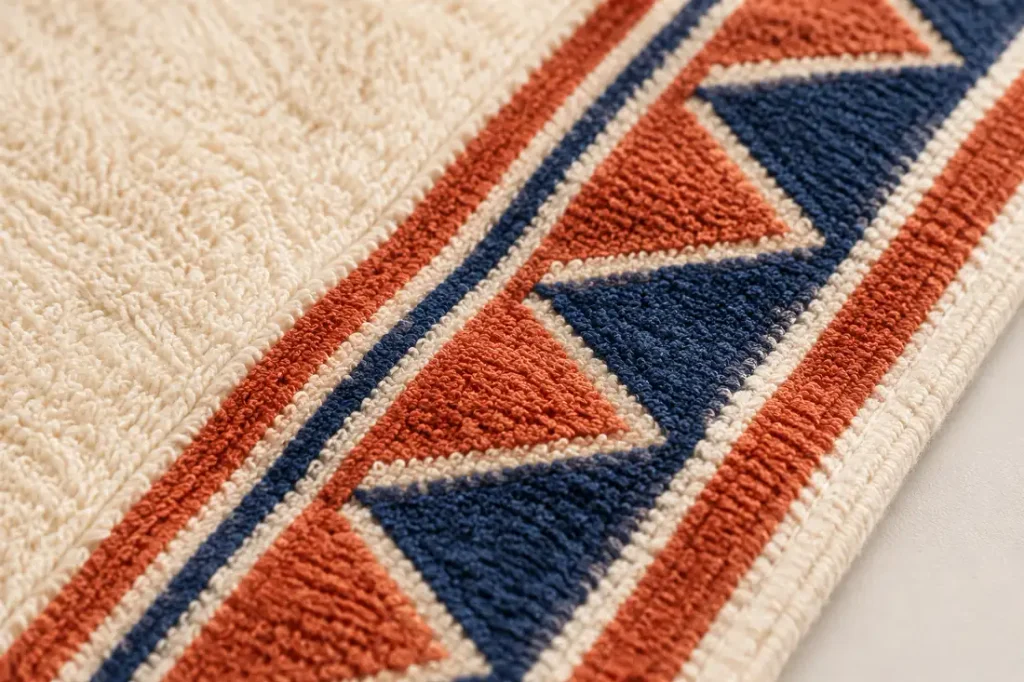
Jacquard. The design is woven into the towel using coloured yarns, so the pattern is part of the fabric. It cannot crack, peel or fade off, and it survives chlorine and industrial washing better than any surface application. Jacquard is the right choice for resort logos, cabana stripes and hotel pool programs where the towel must look the same after 50 washes. The constraint is setup: a Jacquard loom needs a design-specific programme and a warp setup, which pushes the minimum order up and the sampling time out, and it is the main reason a first wholesale beach towels order often starts with a simpler banded design. Simple geometric and banded designs cost far less to set up than photographic or multi-colour artwork.
Velour. A smooth, cut-pile face that takes print well and feels softer than terry loop. Velour towels are common in retail and promotional programs where the print is the product. The face is more prone to showing wear than loop pile, so it suits retail replacement cycles better than resort laundry.
Reactive print. Dye printed onto cotton and fixed, so the colour sits in the fibre rather than on top of it. Good colour depth on photographic artwork, better wash fastness than pigment print, and usually the best balance for resort retail and gift shops.
Sublimation. Polyester-only, full-bleed photographic colour, edge to edge. Excellent for photo and licensed merchandise, and unsuitable where cotton hand feel or chlorine exposure matters.
A practical rule: if the towel is going into a laundry cycle more than 30 times, specify Jacquard. If it is going home with a guest, print is fine and cheaper. Most wholesale beach towels for resorts sit in the first group, which is why the design conversation usually starts with the loom rather than with the artwork.
Cotton, cotton-poly and the chlorine problem in wholesale beach towels
Beach towels are exposed to pool water, sunscreen and sun, which is a harsher combination than a hotel bath towel ever sees.
100% cotton gives the best absorbency and hand feel. Combed or ring-spun cotton resists pilling better than open-end yarn. The weakness is colour retention under chlorine; reactive dyeing with a documented colourfastness rating is what protects the design.
Cotton-poly blends dry faster, hold colour longer and cost less, at the expense of absorbency and the premium feel. They are common in promotional and volume resort programs where drying capacity is the constraint.
Whatever the fibre, ask for the colourfastness test result to chlorine and to light. A towel that fades from navy to grey in one season generates complaints that no unit-price saving covers. This matters more for pool decks in strong sun than for retail shelves.
A second test worth requesting is shrinkage after five washes. A cotton beach towel that pulls in length stops covering the lounger, and a resort that has ordered 400 of them cannot fix that with a reorder. Pre-shrunk yarn and a stated finished size after washing are the two things that prevent it.
Custom branding beyond the weave
If the design is woven or printed, the branding question is settled. If it is not, the logo can be applied in three ways, each with a different durability profile.
Embroidery. The most premium option and the most durable. Works well on a dobby band or a corner. Adds cost per logo and needs a digitised file; placement must be specified, because a logo embroidered across a terry loop disappears into the pile.
Woven label. A sewn-in label at the hem. Cheap, durable, and the standard for hotel and resort programs that need identification more than decoration.
Printed transfer or screen print. Lowest cost, fastest setup, least durable. Suitable for promotional towels with a short life.
For most resort programs the combination that works is a Jacquard band plus an embroidered or woven-logo detail — one carries the identity, the other carries the brand name, and neither depends on a surface application surviving the wash.
Sampling, MOQ and seasonal timing
Beach towels are a seasonal product, and the calendar is the real constraint. Resort programs order before the season opens; retail programs order even earlier, because the goods have to be on shelf before the weather turns.
A realistic sequence: approve artwork, then a strike-off or loom sample, then a production slot. Jacquard sampling takes longer than print because the loom has to be set. If you are buying for a June opening, the artwork decision usually needs to be made in the first quarter, and the order placed with enough buffer for production plus ocean freight.
Minimum order quantity is driven by two things: the design setup and the yarn colour. A stock ground with one woven band carries a much lower minimum than a fully custom multi-colour Jacquard. Ask for the minimum per design, not per order, and ask whether a stock ground can be used to bring the minimum down for a first season.
Packing and landed cost
Beach towels are light for their volume, so carton efficiency matters more than unit price differences of a few cents.
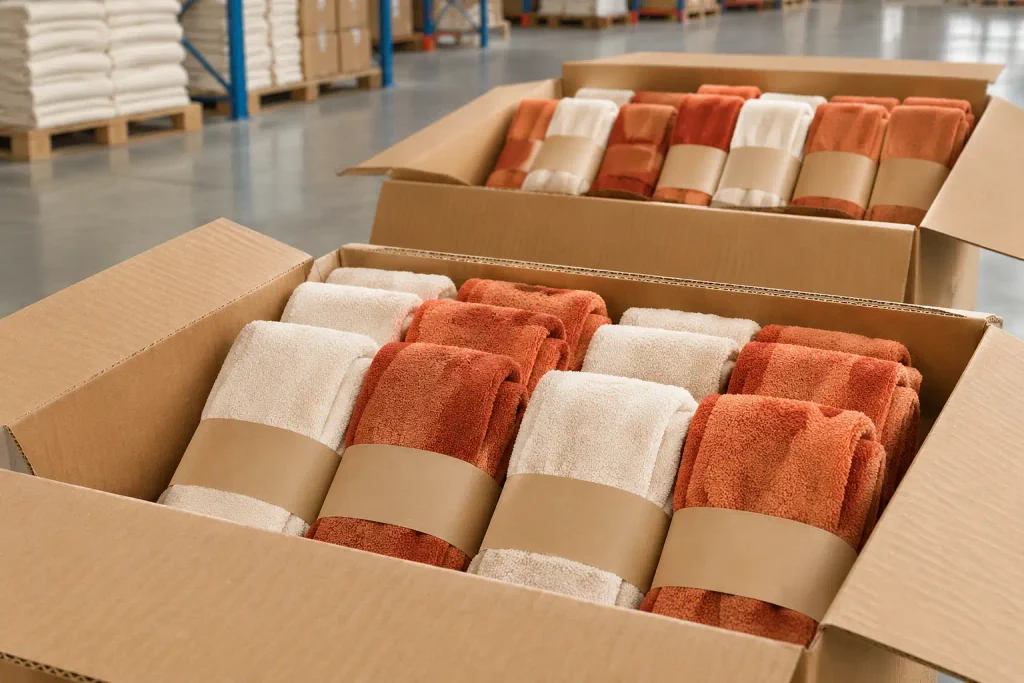
Ask three questions. How many units per carton? What are the carton dimensions and weight? Is the towel folded, rolled or polybagged? A rolled and banded towel looks better in retail and takes more volume; a flat-folded towel packs tighter for resort store rooms.
For resort replacement programs, consider ordering in two shipments rather than one: an opening stock plus a mid-season top-up. Towel loss is front-loaded in the season, and a single large shipment ties up capital and storage.
The worked example is worth doing once with your own numbers. A 90 × 170 cm towel at 500 GSM is about 765 g of fabric. Add a sleeve, a band and a carton, and 500 pieces land somewhere near 400 kg. If the carton holds 20 pieces at 60 × 40 × 40 cm, the consignment occupies roughly 2.4 cubic metres. That volume, multiplied by the freight rate, is often larger than the difference between the two quotations you are comparing. Ask for the packed volume before you choose on unit price.
A buying checklist for wholesale beach towels
- GSM with a stated tolerance, and the test method used
- Finished size after washing, not greige size
- Pile type: loop terry, velour or cut pile
- Fibre content and yarn type (ring-spun, open-end, combed)
- Design method and its minimum order
- Colourfastness to chlorine and to light, with test results
- Border and hem construction: dobby, cam border, whip-stitch, fringe
- Logo application method and placement
- Packing: units per carton, carton dimensions, fold or roll
- Lead time for sample, strike-off and bulk
Run the checklist in this order and the order changes what you can ask for. Size and GSM are fixed early because they drive freight; design method is next because it drives minimum order; colourfastness and border construction come at sample stage, when they can still be changed without a loom reset. Buyers who leave the design method until after the sample is approved usually end up paying for a second sample or accepting a print they did not want.
Where wholesale beach towels sit in the towel program
Beach and pool towels are usually bought with the rest of the towel line, and the specification logic should be shared: GSM, size and colourfastness quoted per line, and one supplier for bath, hand, face and pool so that colours match across a property.
El beach and pool towel range covers Jacquard, velour and printed builds, the hotel towel program covers the full outlet set, and wholesale bath towels is the companion line for guest bathrooms. If the order is part of a wider property fit-out, the wholesale bedding program is where mixed containers are quoted.
There is a commercial reason to buy the towel line as one order. Colours have to match across bath, hand and pool towels in the same bathroom and on the same deck; buying them from different suppliers on different dye lots produces a visible mismatch that no amount of matching by name fixes. One supplier, one colour standard, one shipment is the simpler specification.
PREGUNTAS FRECUENTES
What GSM should a beach towel be? 400–600 GSM covers most uses. Resort pool decks usually land at 450–550; retail and promotional towels at 400–450 to keep weight and cost down. Above 600 the towel dries slowly and costs more to ship.
What is the standard beach towel size? 80 × 160 cm is the most common retail and resort format, with 70 × 140 cm for pool decks and 90 × 170 cm for premium and cruise programs.
Which print method lasts longest? A woven Jacquard design, because the pattern is made of yarn rather than applied to the surface. Among print methods, reactive print on cotton outlasts pigment print, and sublimation lasts well but only works on polyester.
Can beach towels be customised with a logo? Yes — woven into the design, embroidered, or applied as a woven label. Embroidery and Jacquard are the durable options; printed transfers are the cheapest and the shortest-lived.
How far in advance should I order? Work backwards from the season opening. Artwork approval, sampling, production and ocean freight typically need several months, and Jacquard sampling adds time. Ordering in the first quarter for a summer season is the normal pattern.