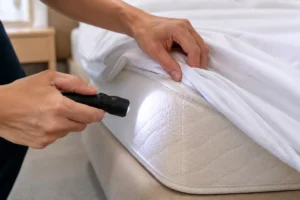
What Is a Duvet Insert?
A duvet insert is the filled bag that goes inside a duvet cover. It is the part that provides warmth. The cover is the part that touches you and the part that gets washed. Two pieces, two jobs.
That split is the reason the duvet insert exists as a product at all. A comforter is sewn shut and washed whole, which means a large heavy item in a domestic machine every few weeks. A duvet insert stays protected inside a cover, so the fill only sees water two or three times a year and the cover takes the weekly laundering.
Once you understand that, most of the buying questions answer themselves. Fill type decides how warm the duvet insert is for its weight. Construction decides whether the fill stays where the factory put it. Size decides whether the cover fits.
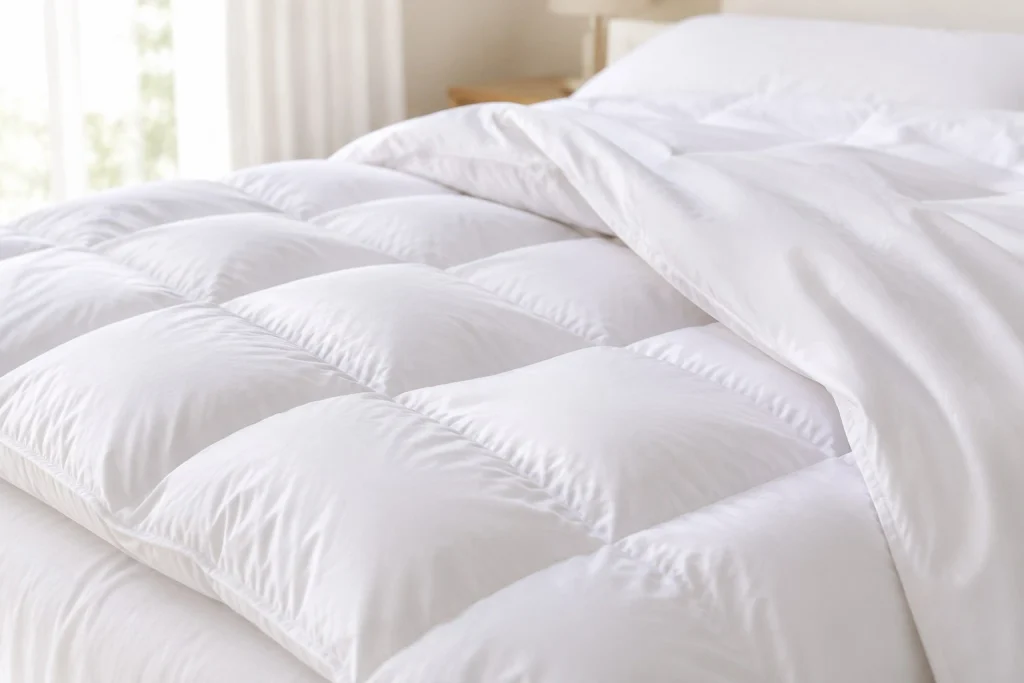
How a duvet insert differs from a comforter
People use the two words interchangeably, which causes a lot of bad purchases.
| Duvet insert | Comforter | |
|---|---|---|
| Structure | Filled bag, no decorative face | Filled and finished in one piece |
| Washable surface | Needs a cover | The comforter itself |
| Wash frequency | Two or three times a year | Every few weeks |
| Typical fill | Down, down alternative, wool, silk | Polyester, sometimes down |
| Used in hotels | Yes | Rarely |
A quilt is a third thing. It is thin, usually decorative, and sits on top of the bed rather than replacing a duvet insert unless the room is very warm.
The practical consequence is lifespan. A duvet insert washed twice a year lasts a decade or more. A comforter washed twenty times a year starts to flatten in two or three seasons, because every wash cycle puts the fill through heat and mechanical agitation. A comforter also cannot be repaired. Once the shell wears through, the whole item goes.
The fill options
Down. The undercoating of ducks or geese, graded by fill power. That number is the volume in cubic inches that one ounce of down occupies. 550 to 600 is standard, 700 is good, 800 and above is premium. Higher fill power means more warmth for less weight, which is why a 700 fill duvet insert feels lighter than a 550 one at the same warmth.
Down alternative. Synthetic fill, usually siliconized polyester or a microfiber cluster built to imitate down. It is measured in grams per square metre rather than fill power. Cheaper, fully machine washable, and the right answer for allergy-sensitive buyers and for properties that launder hard. It does flatten: expect visible loss of loft somewhere between 30 and 50 commercial washes.
Wool. Good temperature regulation and naturally flame resistant, which is why it turns up in contract and healthcare specifications. Heavier than down for the same warmth, and it needs careful drying.
Silk. Light and breathable, popular in warm climates and in premium retail. Expensive, and it does not enjoy commercial laundering.
Cotton. Heavy, cheap, and rarely used outside specific regional markets. It does not loft, so a cotton duvet insert behaves more like a quilt.
Construction decides how long it lasts
Two duvet inserts can match on fill weight and shell and still perform completely differently, because construction decides whether the fill can move.
Baffle box construction sews fabric walls between the top and bottom shell. Each chamber is three dimensional, the fill lofts to full height, and it cannot cross from one box to the next. This is the standard for hotel duvet inserts and the reason a good one still looks plump after a year.
Sewn-through construction stitches the top shell straight to the bottom in a grid. It is faster and cheaper to make. The stitch points are cold spots, and the fill migrates along the channels. On a cheap duvet insert, sewn-through is why one end feels empty after a few months.
Gussets are the side walls that add height. A three centimetre gusset gives the fill more room and changes how the duvet insert drapes over the edge of the mattress.
Shell fabric matters as much as the fill. A 100 percent cotton shell at 300 thread count with a down-proof weave holds fill better than a 200 thread count shell, and it survives commercial laundering without seam slippage. Thin polyester shells are the usual reason fill starts poking through after a year.
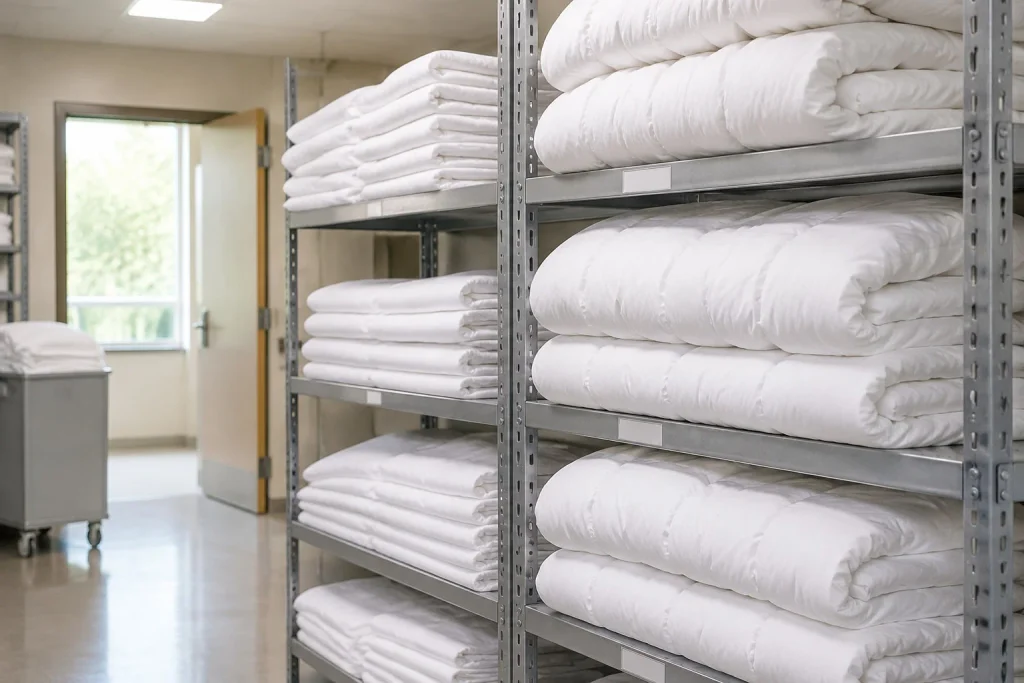
Warmth: TOG and GSM
TOG measures thermal resistance and is the standard European way to describe warmth. It is what you use when specifying for different climates.
| TOG | Warmth | Typical use |
|---|---|---|
| 4.5 | Light | Summer, warm rooms, tropical hotels |
| 7 to 9 | Medium | Spring and autumn, air-conditioned rooms |
| 10.5 to 12 | Warm | All-season in temperate climates |
| 13.5 to 15 | Extra warm | Winter, cold rooms, unheated buildings |
GSM is grams per square metre of fill. Factories quote it because it can be weighed at inspection, and it is the number that belongs on a purchase order. The two measurements correlate but they are not the same. A down duvet insert and a polyester one at the same TOG will differ in GSM, because down lofts more per gram.
For bulk buying, specify both. TOG describes the sleeping experience. GSM describes what will actually be on the scale. European tenders tend to quote TOG while Asian mills quote GSM, so a buyer usually ends up holding both numbers at once.
Sizes and fill weights
Duvet insert sizes follow the bed, but the exact dimensions differ by market and a queen from one supplier is not always a queen from another.
| Größe | Insert | Cover | Fill, all-season |
|---|---|---|---|
| Zwillings | 68 × 88 in | 68 × 90 in | 500 to 700 g |
| Full / Queen | 88 × 92 in | 90 × 94 in | 800 to 1,100 g |
| König | 104 × 92 in | 106 × 94 in | 1,200 to 1,600 g |
| Oversized King | 110 × 98 in | 112 × 100 in | 1,500 to 1,900 g |
The cover should run two to four inches larger than the duvet insert on each side. Less than that compresses the fill at the edges. More than that and the insert moves around. If you buy the two separately, order from the same specification and put a tolerance on the insert, plus or minus one inch.
What hotels specify, and why
Hotel specifications settle on a small number of choices, and almost all of them are about laundry rather than comfort.
White shell, because white can be bleached and inspected for stains. Baffle box with corner loops, so housekeeping can tie the duvet insert into the cover. 300 thread count cotton shell with down-proofing, because it holds fill and survives sixty-plus commercial cycles. Down alternative at 250 to 300 GSM for most mid-market properties, because it washes well and dries fast. Down at 600 to 700 fill power for premium rooms, where the feel is part of the rate.
The specification most often left out is the wash cycle target. A duvet insert that looks right on delivery and flattens after twenty washes is a bad buy whatever it cost per unit. Ask for the wash test result, not just the fill weight. Ask as well whether the shell is bleached or optically white, because bleach tolerance is what keeps a white duvet insert white across sixty cycles.
Care and lifespan
Wash two or three times a year at home, more often in a rental where the duvet insert is used without a cover. Front loader, mild low-foaming detergent, no softener, extra rinse. Low heat with dryer balls over two or three cycles, breaking up damp clumps by hand between cycles.
Stored that way, a down duvet insert lasts 10 to 15 years, down alternative 3 to 5 years, wool 5 to 8 years with careful drying. The usual causes of early failure are softener build-up, which flattens loft, and months in a vacuum bag, which damages down clusters permanently.
Store it loosely folded in a cotton bag and air it for an hour before it goes back on the bed, in shade rather than direct sun, which weakens cotton over a few summers. For a property, number each insert, record the wash date, and retire it at the rated cycle count rather than waiting for it to fail in a room.
Frequently asked questions
Do you need a cover for a duvet insert? Yes. The duvet insert has no washable decorative surface and is not designed to be slept under directly. A cover protects the fill, keeps washing down to a few times a year, and takes the weekly laundry.
Is a duvet insert the same as a comforter? No. A comforter is filled and finished in one piece and washed as a whole. A duvet insert is a separate component used inside a removable cover, which is why it lasts longer and is the standard in hotels.
What is the best fill for a duvet insert? Down at 600 to 700 fill power for warmth-to-weight and life span. Down alternative at 250 to 300 GSM for machine washability, allergies and hard commercial laundering. Wool for contract and healthcare specifications. There is no single answer without knowing the wash cycle and the climate.
What TOG should I choose? 4.5 for summer and tropical climates, 9 to 10.5 for all-season in temperate climates, 13.5 or above for cold rooms. If one duvet insert has to work year round in an air-conditioned hotel, 9 to 10.5 is the usual compromise.
How often should a duvet insert be washed? Two or three times a year at home, or every 10 to 15 uses in a hospitality setting where it is used without a cover. Washing more often shortens the life of the fill without improving hygiene, because the cover is doing that work.
HEJ Home Textile produces duvet inserts and covers in down and down alternative, in baffle box construction with 300 thread count down-proof shells. See the duvet range or send your specification for bulk pricing.