China’s textile and apparel exports reached about $145.7 billion in 2025, down from $153.0 billion in 2024, according to customs-derived figures reported by Fibre2Fashion in March 2026. The number that matters to a buyer is smaller and harder to find: how much of that volume came from factories that can actually hold a specification across three reorders.
Search “chinese linen manufacturers” and you get hundreds of results with similar websites and certificate walls. Most are trading companies, which is not automatically bad — a good one manages quality and logistics competently. The problem is paying factory pricing for intermediary service, or assuming an audit covers a workshop the seller does not own.
First, pin down what “linen” means
The word is used loosely in Chinese export listings. Three different products hide behind it:
Flax linen
- — woven from flax fibre, the European and North American retail sense of the word.
“Linen” as bedding
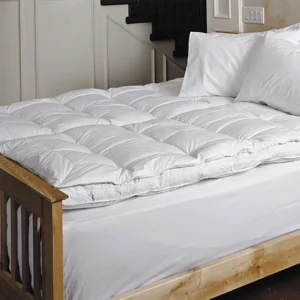
- — sheets, duvet covers and pillowcases of any fibre, the hotel and hospitality sense.
Cotton-linen blends
- — usually 55/45, sold as linen and priced between the two.
Ask for the fibre composition test, not the product title. A supplier quoting “100% linen” at a price below cotton has either mislabelled a blend or is selling a coarse count unsuitable for sheeting.
Where the clusters are
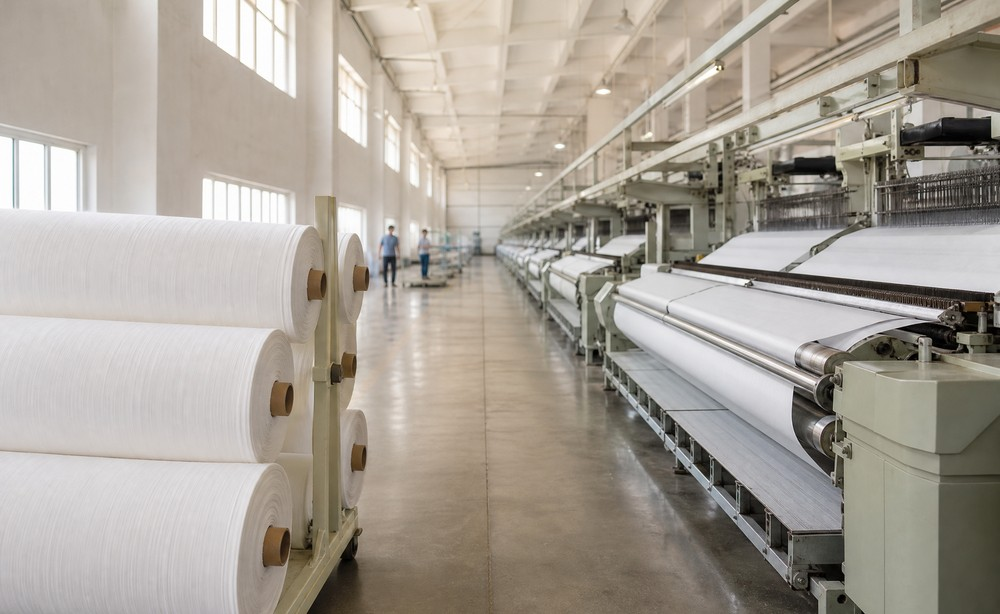
Capability is regional. Home-textile bedding concentrates around Nantong in Jiangsu, where the Dieshiqiao market anchors a dense supplier base covering sheeting, quilts and throws. Fabric weaving and dyeing cluster around Shaoxing’s Keqiao district in Zhejiang.
Practical implication: a supplier quoting bedding, towels, table linen and blankets at identical quality is sourcing from several workshops. That can work — ask which lines are in-house and for each address.
Verify the legal entity in ten minutes
Chinese companies are traceable. A legitimate supplier will share:
Unified Social Credit Code
1. (18 characters) — check it against the company name on the quotation and the bank account on the proforma invoice. Mismatches are the single most common fraud signal.
Business licence scope
2. — does it include manufacture of textiles, or only trading and import/export?
Registered capital and establishment year
3. — a two-year-old company claiming 20 years of mill experience deserves a question.
Export rights registration
4. — without them a factory cannot invoice in foreign currency and will route your order through a third party.
Export evidence beats certificate walls
Ask for a redacted bill of lading or customs declaration from a shipment to your region in the last 12 months. It shows destination, volume and product — three things a certificate cannot.
On certificates, validate rather than admire:
OEKO-TEX Standard 100
- carries a certificate number that can be checked in the OEKO-TEX buying guide. Confirm the certificate holder matches the entity you are paying, and that the product class covers your article.
GOTS
- requires a transaction certificate per shipment, not just a scope certificate. Ask for the TC.
BSCI or SMETA
- audits attach to a specific factory site and expire. Check the site address and the audit date.
ISO 9001
- says a quality system exists. Ask for the corrective-action log; that is where it either works or does not.
The sample protocol that filters most of the field
Pay for samples. Free samples from unknown suppliers are usually bought from a market stall, and what you approve is not what you will receive.
Run three stages: a stock sample to judge base quality; a lab dip or strike-off for colour; and a pre-production sample made to your exact spec sheet, including labels and packaging. Wash the pre-production sample three times at 60 °C and re-measure. Shrinkage above 5%, seam puckering or visible colour loss tells you more than any catalogue.
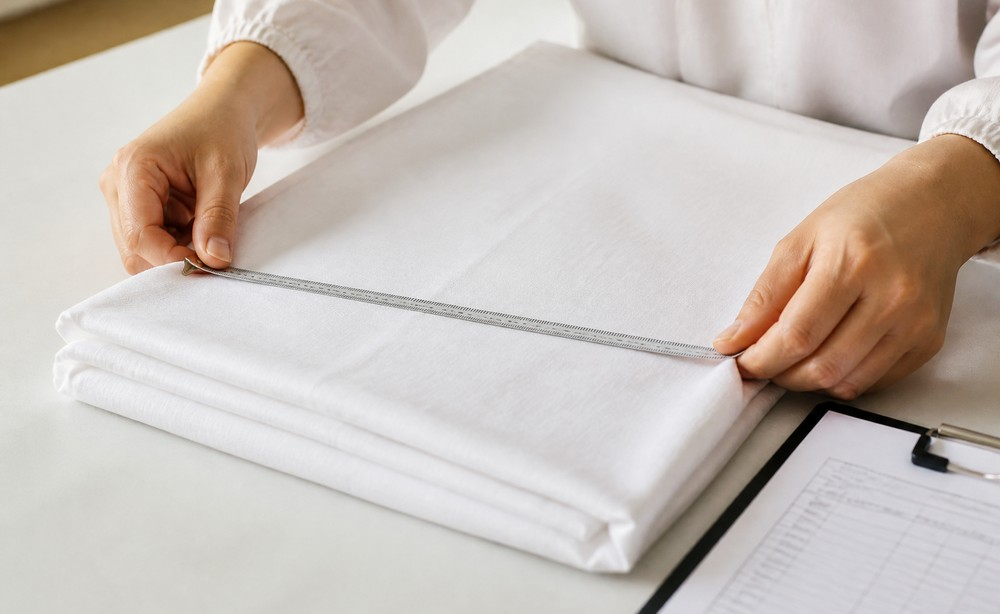
Measuring a pre-production sheet against the spec. Then wash it three times at 60 °C and measure again — that is where shrinkage claims fail.
Before bulk shipment, book a third-party pre-shipment inspection on AQL 2.5 major / 4.0 minor, and put the inspection clause in the PO. Inspection firms quote per man-day; trivial against a container of unsellable sheeting.
Reading the price
When one quote is 20% below the field, the gap is usually one of: lighter fabric than specified, a coarser yarn count, single-needle stitching replaced by overlock, or a trader quoting before confirming mill capacity.
Confirm Incoterms explicitly. FOB Shanghai or Ningbo is standard for full containers; EXW leaves you responsible for export clearance, which a first-time buyer rarely wants.
Payment terms are a risk dial. A 30% deposit and 70% against the bill of lading copy is normal. Full prepayment to a personal account, or to an account name that differs from the contracting entity, is not a negotiation point — it is a stop signal.
Five-step vetting sequence
1. Confirm the fibre composition, then check the credit code, licence scope and export rights.
2. Request redacted shipping documents from the last year.
3. Validate certificates by number and certificate holder, and ask which steps are in-house.
4. Buy samples, wash them three times, re-measure.
5. Put a pre-shipment inspection in the PO, then start with one SKU.
FAQ
Are Chinese linen manufacturers cheaper than European mills? On standard constructions, generally yes. On certified European flax with full traceability, the gap narrows.
How long does a first order take? Sampling runs two to three weeks, bulk 30–45 days, plus inspection and sea freight.
Should I use an agent? Worth it if you cannot visit; the fee is often recovered in avoided rework.