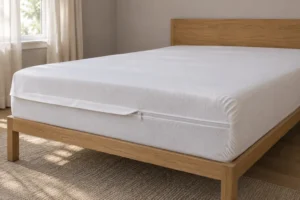
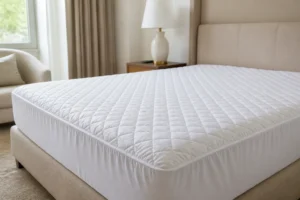
Hospital bed sheet size starts with the mattress: a standard US hospital bed mattress is 36 × 80 inches (91 × 203 cm), and the sheet that fits it is a fitted sheet at 36 × 80 inches with a 9–10 inch pocket, or a flat sheet at roughly 66 × 104 inches. Those two numbers cover the majority of acute-care beds in the US. Everything else — long beds, bariatric frames, low-air-loss surfaces, birthing beds — is a variation on that base, and getting the variation wrong is how a linen order ends up unusable.
The trap is that hospital bed sheet size is not one specification. The mattress, the frame and the surface type each change what fits, and a fitted sheet that is 2 inches short in the pocket will pop off the corner the first time the head of the bed is raised. This guide gives the working sizes, the depth math, and what to write into a tender so the sheets actually stay on.

Standard hospital bed mattress sizes
The base dimensions below are the common US clinical sizes. They are starting points for a specification, not a substitute for measuring the beds in the building — a facility that has replaced mattresses over a decade will have a mix.
| Bed type | Mattress size (in) | Mattress size (cm) | Typical use |
|---|---|---|---|
| Standard hospital | 36 × 80 | 91 × 203 | General wards, most acute care |
| Standard long | 36 × 84 | 91 × 213 | Taller patients, some newer facilities |
| Wide / heavy-duty | 42 × 80 | 107 × 203 | Bariatric-capable frames |
| Bariatric | 48 × 80 | 122 × 203 | Dedicated bariatric rooms |
| Bariatric extra-wide | 54 × 80 | 137 × 203 | High-acuity bariatric units |
| Pediatric | 36 × 72 or 30 × 72 | 91 × 183 / 76 × 183 | Pediatric wards |
| Birthing bed | 36 × 80 (frame extends) | 91 × 203 | Labor and delivery |
The hospital bed sheet size you order follows the mattress, not the frame, but the two are worth measuring together because a wider frame usually means a wider mattress. Two practical notes. First, width varies more than length in real buildings: 36 inches is standard, but a facility that has standardized on 42-inch frames has effectively created a second SKU for every linen item, not just the sheet. Second, mattress depth is a separate number from mattress size and it is the one that fails most often — see the depth section below.
What size sheets fit those mattresses
Hospital bed sheet size is specified two different ways: as flat dimensions for a flat sheet, and as width × length × pocket depth for a fitted sheet.
| Sheet | Size (in) | Fits |
|---|---|---|
| Fitted sheet, standard | 36 × 80 × 9 | 36 × 80 mattress up to 9 in deep |
| Fitted sheet, deep | 36 × 80 × 12 | 36 × 80 mattress with a topper or pressure-relief surface |
| Flat sheet, standard | 66 × 104 | 36 × 80, with tuck allowance |
| Flat sheet, large | 70 × 104 | 36 × 84 or 42 × 80 |
| Flat sheet, bariatric | 90 × 104 | 48 × 80 and wider |
| Draw sheet | 54 × 90 | Repositioning and transfer, all standard beds |
The flat sheet needs more overhang than a domestic sheet because clinical beds are made with hospital corners and the sheet has to stay tucked when the head elevates. A 66-inch wide flat sheet on a 36-inch mattress leaves 15 inches of drop per side, which is enough for a hospital corner with a margin; a 60-inch sheet leaves 12 inches, which looks adequate on a flat bed and pulls out the first time the frame articulates.
For fitted sheets, the pocket depth must exceed the compressed mattress depth plus any surface overlay. A 9-inch pocket on a 9-inch mattress fits exactly, which means it fits badly — there is no margin for the sheet to tuck under, and the corner lifts. Specify a pocket at least 1 inch deeper than the measured mattress height.
Fitted versus flat in a clinical setting
Most US hospitals use a flat sheet as the base layer and a fitted sheet as a convenience on lower-acuity beds, and the split is driven by laundry economics rather than preference.
Flat sheets are cheaper per unit, easier to iron and press, and they tolerate being used as a draw sheet or a cover in a pinch. Their weakness is labor: a hospital corner takes time, and a badly made bed with a flat base sheet wrinkles under the patient, which matters on a pressure-relief surface. Fitted sheets make the bed faster and hold flatter, but they are size-specific — one wrong pocket depth and the whole carton is useless — and they wear at the elastic long before the fabric fails.
The pattern that works in practice is fitted base sheets on standard wards where bed-making time is the constraint, and flat sheets in areas where the sheet doubles as a transfer aid or where the bed frame changes often. Facilities running both should color-code the fitted sheets by depth, because a 12-inch fitted sheet on a 7-inch mattress looks almost right until the second wash.
Depth, shrinkage and the allowance that gets missed
Mattress depth on a clinical bed runs from about 6 inches on a basic foam mattress to 10–12 inches on a pressure-redistribution surface, and 14 inches on some low-air-loss systems with the cover fitted. Measure at the corner with the mattress on the frame and the patient load off; measuring the bare mattress on a table gives a smaller number than the bed will.
Then add laundry allowance. A cotton-rich sheet will shrink 3–5% on the first wash and settle at 2–3% after that; a 50/50 poly-cotton shrinks 1–2%. On a 80-inch length, 3% is 2.4 inches — enough to turn a correct fitted sheet into a short one. Contract sheets should be pre-shrunk and specified with a maximum residual shrinkage, and the pocket depth should be quoted after shrinkage, not before.
This is also why hospital sheets are usually a poly-cotton blend rather than pure cotton. The blend holds size through 100+ commercial washes, dries faster, and takes the higher temperature the laundry needs for thermal disinfection. Pure cotton feels better on the first night and is 2 inches short by the twentieth wash.
Specialty beds that break the standard
Four bed types routinely fall outside the standard 36 × 80 assumption, and each one needs its own SKU.
Low-air-loss and alternating-pressure surfaces. These mattresses are thicker and often have a fitted cover that must not be occluded. The sheet has to be loose enough not to bridge the therapy surface and tight enough not to wrinkle; deep-pocket fitted sheets at 12 inches, or flat sheets used without tucking the sides, are the usual answer.
Bariatric frames. Widths of 42, 48 and 54 inches mean a separate flat sheet size, and often a separate draw sheet and a heavier-duty fitted sheet. Reinforced corners matter here — a standard corner seam fails under the extra tension of a wider bed.
Birthing beds. The frame extends and the foot section detaches, so the base sheet has to tolerate a length change mid-use. Flat sheets are the norm.
Pediatric and neonatal beds. Cots and incubators use much smaller sizes, often 30 × 72 or custom, and the sheet is frequently a shaped item rather than a rectangle. These are usually bought on a separate contract and should not be folded into an adult-bed tender.
Care home and aged care sizes
Aged-care beds are usually the same 36 × 80 base as a hospital bed, but the surrounding specification differs, and buyers who treat care homes as small hospitals over-specify the sheet and under-specify the protector.
Care homes run lower wash temperatures and fewer thermal disinfection cycles, so a higher cotton content is viable and often preferred for comfort. They also use more profiling beds, which means the fitted sheet depth needs the same treatment as acute care — a profiling frame puts more strain on the corners than a flat bed. Incontinence is a bigger factor than in general wards, which is why the غطاء فراش مقاوم للماء specification usually matters more to the resident’s comfort than the sheet thread count.
The sheet sizing rule does not change: measure the mattress, add the overlay, add 1 inch, and buy the pocket depth that results. What changes is the fabric weight and the wash temperature the sheet must survive.
What to write into a tender
A hospital bedding tender that specifies “standard hospital sheets” will receive five different products. Hospital bed sheet size has to be written as numbers, with tolerances, or the bid comparison is meaningless — the specification below is the minimum that produces comparable quotes.
Dimensions with tolerances. Fitted: width × length × pocket depth, with the pocket measured after shrinkage. Flat: width × length. State the tolerance — ±1 inch on width is normal, ±0.5 inch on pocket depth is not unreasonable for contract work.
Fabric. Composition, yarn count or GSM, and whether it is pre-shrunk. A 130 gsm 50/50 poly-cotton is a different product from a 110 gsm one, and the difference shows in wash life, not in the sample.
Shrinkage and wash life. Maximum residual shrinkage after five washes, and the number of industrial wash cycles the sheet is warranted for at a stated temperature.
Barrier and fluid resistance. Whether the base sheet needs fluid resistance, or whether that job is carried by the protector underneath. Deciding this in the tender avoids paying twice.
Color and coding. Ward color-coding, if used, plus colorfastness to washing and to chlorine, since hypochlorite is still used in some facilities.
Elastic and construction. Elastic type and width on fitted sheets, seam type, and whether corners are reinforced. This is where the cheapest quote hides its savings.
A tender that lists these six items will still produce a spread in price, but the spread will be attributable to something. Without them, the cheapest quote wins and the ward finds out in month three.
الأسئلة الشائعة
What is the standard size of a hospital bed sheet? For a standard 36 × 80 inch hospital mattress, a fitted sheet is 36 × 80 inches with a 9–10 inch pocket, and a flat sheet is about 66 × 104 inches. Bariatric and long beds need different sizes.
Are hospital bed sheets the same as queen sheets? No. A queen flat sheet is around 90 × 102 inches — long enough but far too wide for a 36-inch mattress, and it will pool at the sides and wrinkle under the patient.
What pocket depth do I need? Measure the mattress on the frame, add the depth of any overlay or pressure-relief surface, add 1 inch of margin, then add the shrinkage allowance. A 9-inch mattress with a 2-inch overlay needs a 12-inch pocket.
Do hospital sheets shrink? Cotton-rich sheets shrink 3–5% on the first wash; poly-cotton blends shrink 1–2%. Contract sheets should be pre-shrunk and specified with a maximum residual shrinkage.
Can I use standard fitted sheets on a profiling bed? Only if the pocket depth has margin. A profiling frame puts more tension on the corners than a flat bed, so a sheet that fits exactly on a flat frame will lift when the head section elevates.
Sizing the order
Take three measurements per bed type — mattress length, width and depth on the frame — and one wash temperature from the laundry. Send those with the bed count per ward and the barrier requirement, and the sheet specification falls out of it.
It is worth recording the measurements as a table you keep, because the same numbers drive the next three purchases: sheets, protectors and encasements all reference the mattress depth, and a facility that measures once avoids the situation where the sheets fit but the encasement does not. Note the bed manufacturer and model alongside the dimensions if you have it; replacement mattresses from the same range usually repeat the depth, which makes future orders predictable.
For phased procurement, order the wards with the oldest bedding first and treat the first ward as the fit test. Two weeks of real use will tell you more about pocket depth and elastic recovery than any sample, and a single-ward order is a cheap way to validate the specification before the main tender. If the ward reports corners lifting, the pocket depth is the variable to change, not the fabric.
Browse the hospital bedding range for the base sheet and protector combinations that ship together, and send your per-ward bed counts with the measured depths for a sized quotation with the shrinkage allowance already applied.