The difference between OEM and ODM is who owns the design. In OEM, you bring the specification — fabric, fill weight, dimensions, packaging — and the factory builds to it. In ODM, the factory already has the product and you put your label on it. OEM buys you differentiation and costs you time and tooling; ODM buys you speed and a low entry point, and hands your competitor the same product with a different tag.
For a bedding brand, that choice decides almost everything downstream: your MOQ, your margin, how long the first order takes, whether you can claim an exclusive, and how much of the compliance work lands on you. This is the working difference, not the textbook one.
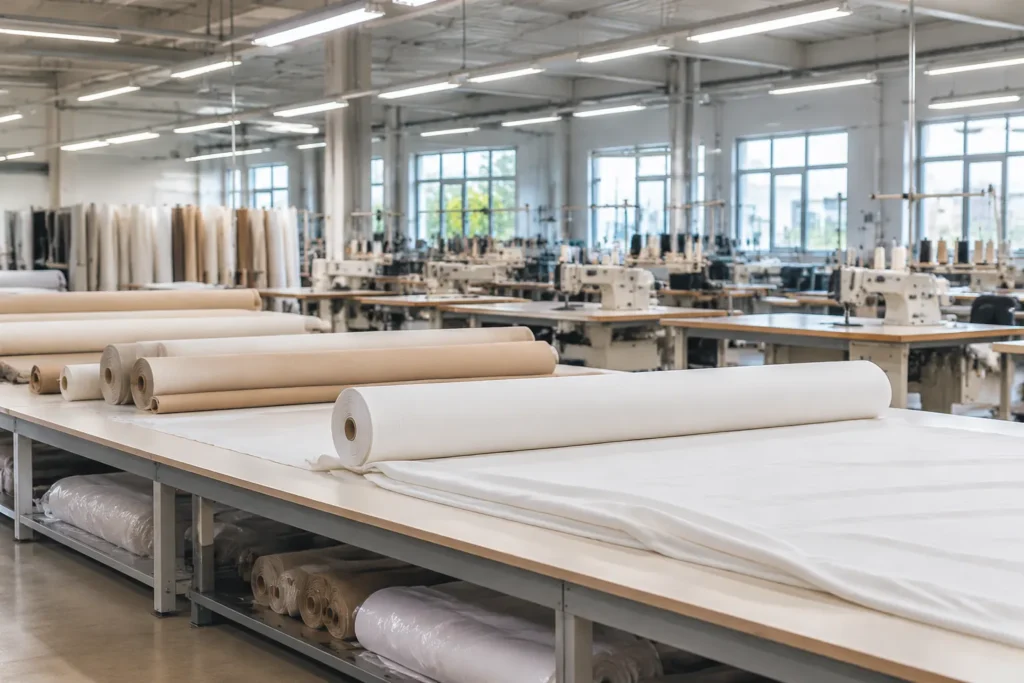
What OEM means in bedding
OEM — original equipment manufacturing — means the factory manufactures to your design. You specify the shell fabric and its thread count, the fill and its weight in grams, the finished dimensions and tolerances, the quilting pattern or baffle construction, the label placement, the polybag, the carton markings. The factory quotes against that specification and produces it.
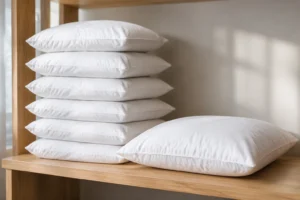
In bedding this usually starts with a tech pack: a one-page document with a flat sketch, a measurement table, a bill of materials with tolerances, construction notes and packaging. A pillow tech pack, for example, might specify a 300-thread-count down-proof cotton shell, 700 g siliconized hollow fiber fill, 50 × 70 cm finished size with a 1 cm tolerance, a woven label at the left seam and a PE bag with a euro hole. Everything in that list is a decision you own.
The commercial consequence is that OEM requires tooling and setup investment. Custom jacquard weaving means a loom setup; a custom printed shell means engraving and a minimum print run; a custom size means a pattern and a cutting die. Those costs are quoted as one-off charges and they are not refundable if the design does not sell. In exchange, the product is yours — the specification is not in the factory’s catalog, and a competitor cannot order it by name.
What ODM means in bedding
ODM — original design manufacturing — means the factory already developed the product and offers it to multiple buyers. You choose from a range, apply your brand, and ship. The design, the pattern, the fill weight and the construction are the factory’s decisions; you are selecting and branding, not engineering.
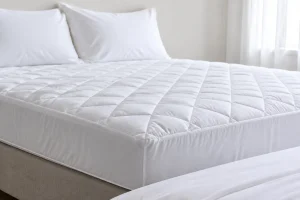
This is what most people mean when they say private label, although the two terms are not identical: private label is the branding arrangement, ODM is who did the design work. In practice a first bedding range is almost always ODM — a stock 233-thread-count microfiber sheet set in four colors, or a standard 200 gsm quilted protector in three sizes, with your label and your carton.
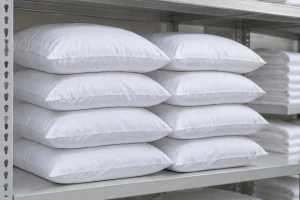
The economics are simple. No tooling charge, no pattern cost, MOQ in the low hundreds per color rather than the thousands, and sampling in days rather than weeks because the sample is pulled from existing production. What you give up is exclusivity. The same ODM pillow may be on three other brands’ sites this quarter, differing only in the label and the polybag. If your positioning depends on being different, ODM alone will not get you there.
OEM vs ODM side by side
| Dimension | OEM | ODM |
|---|---|---|
| Who owns the design | You | The factory |
| Starting MOQ per SKU | 1,000–3,000 units typical for custom fabric; lower for stock fabric with custom size | 200–500 units per color |
| Tooling and setup | Paid by you, one-off | None |
| Sampling time | 2–4 weeks for first sample rounds | 3–7 days, sample from stock |
| Unit cost at same quality | Lower at volume | Higher per unit, but no setup |
| Exclusivity | Yes, if contracted | No, unless you buy it |
| Time to first shipment | 8–14 weeks | 3–6 weeks |
| Differentiation | High | Low to none |
| Your workload | Tech pack, approvals, compliance | Selection, labeling, compliance check |
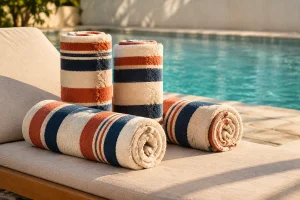
The MOQ and timing figures are planning ranges from contract bedding production, not a rate card; they move with fabric type, color count and season. A custom jacquard beach towel and a stock microfiber pillowcase are both “OEM” and differ by an order of magnitude in minimum quantity.
The cost structure nobody explains properly
Buyers comparing OEM and ODM quotes usually compare unit price and conclude ODM is cheaper. At small volumes it is. The crossover point is worth calculating, because it arrives earlier than most first-time brands expect.
Take a pillow. An ODM stock pillow might quote at $7.50 with a 300-unit minimum. An OEM version of the same pillow with a custom shell, custom fill weight and your label might quote at $6.80 with a 1,500-unit minimum plus $900 in setup. At 300 units, ODM costs $2,250 and OEM costs $2,940 in setup and goods — ODM wins. At 3,000 units, ODM costs $22,500 and OEM costs $21,300 — OEM wins, and you own the specification.
In OEM vs ODM terms, the crossover volume is the point where the lower unit price has repaid the setup cost. For most bedding items it lands between 1,000 and 2,000 units per SKU, which is exactly the volume a brand reaches in its second or third season if the first product works.
The second cost is change cost. With ODM, switching supplier means switching product: new fill, new feel, new reviews. With OEM, the tech pack travels; a second factory can quote the same specification, which is your only real defense against a price increase in year two. That optionality does not appear in either quote and is usually worth more than the unit-price difference.
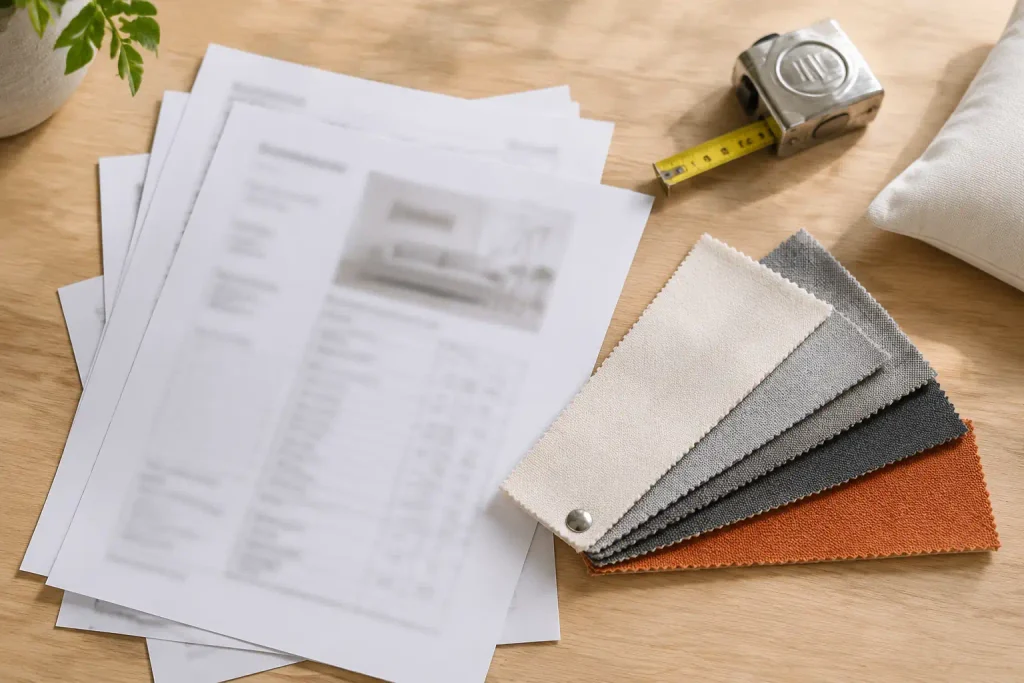
IP, exclusivity and tooling
OEM does not automatically give you intellectual property. It gives you a specification that the factory builds for you, and what protects it is the contract, not the design itself. Three clauses do the work.
Tooling ownership. State that dies, screens, print engravings and patterns paid for by you remain your property and must be returned or destroyed on request. Without this, the setup you paid for can be reused for another buyer.
Exclusivity period. Ask for a defined window — commonly 12 to 24 months — during which the factory will not produce the same construction and colorway for another buyer in your market. Geographic scope matters: exclusivity in the US is cheaper than worldwide.
Confidentiality of the specification. A tech pack is commercially sensitive; a fill weight and a shell construction are the product. An NDA that covers the tech pack, the samples and the mould list is standard, and a factory that resists signing one is telling you something.
ODM has a different version of the same problem. If you want an ODM product exclusively, you are typically buying it: a color exclusivity fee, a commitment to a higher MOQ, or an outright development payment that converts the item to your design. Anything less and the item is shared.
Compliance, labeling and who carries the risk
In both models the brand on the label carries the legal responsibility, but the work is distributed differently. Under ODM the factory’s existing test reports usually cover the base product, and you are verifying that the report matches the SKU you are buying — same fabric, same fill, same construction. Under OEM you are commissioning tests against your specification.
The documents to ask for either way: an OEKO-TEX Standard 100 certificate with the certificate number and the article range it covers, fiber content confirmation for the labeling, care instructions that match the actual construction, and the flammability test report applicable to the specific product. Mattress pads and encasements sold as part of a mattress set can fall under US flammability rules that do not apply to a pillow, so confirm with the factory which standard the SKU was tested to rather than assuming one report covers the range.
Labeling is where first-time brands get caught. US rules require fiber content, country of origin and care instructions on a permanently attached label, and the care instruction has to be truthful for the construction — a “machine wash warm, tumble dry low” claim on a protector with a coated backing that delaminates at 60 °C is a returns problem and, eventually, a compliance one. Under ODM ask to see the factory’s standard label; under OEM, write the label content into the tech pack and approve the artwork before production.
Which model fits which stage
The honest answer is that most brands use both, in sequence. The OEM vs ODM decision is not a permanent identity — it is a decision about what you are selling this year, and it can be revisited when the volume or the proposition changes.
Testing a category — ODM. You need 300 units, three colors, live in six weeks, and you need to learn whether anyone buys. Paying for tooling before you have a first sale is the most common way a bedding brand runs out of cash.
Building a brand with a point of view — OEM. If the proposition is “600 GSM towels” or “the only encasement with a sealed zip guard”, the specification is the brand and it has to be yours.
Scaling a proven SKU — OEM, and move early. The crossover volume arrives faster than expected, and the year-two price negotiation is much easier when a second factory can quote your tech pack.
Selling into retail or hospitality — usually OEM. Buyers specify, tender and compare against a written standard; an ODM catalog item rarely survives a tender specification.
A practical middle path is OEM on the hero SKU and ODM on the supporting range: your own construction on the pillow that carries the brand story, stock constructions on the sheet sets and protectors that fill out the catalog. That keeps the cash requirement bounded and still gives you something a competitor cannot copy by ordering from the same catalog.
Briefing a factory in either model
Whether you go OEM or ODM, the first email decides how the project runs. Send a specification, not a request.
For OEM, the minimum viable brief is: product type and finished dimensions with tolerances, shell fabric with composition and thread count or GSM, fill type and weight in grams, construction notes (quilting pitch, baffle, zip type, seam sealing), color references in Pantone, label and packaging requirements, target quantity per SKU and per color, destination market, and required certifications. Add a photo or sketch of the reference product and say what you want changed.
For ODM, the brief is shorter but not vague: the product category, the size range, the fill or GSM tier you want to sit in, your target landed cost, your label and packaging requirements, and the certificate you need to see. Ask for the factory’s current catalog with fill weights and GSM stated, not just product names — a catalog that lists “premium quilted protector” without a fill weight is not a specification you can compare.
In both cases ask for the same three things before paying a deposit: a pre-production sample with the actual materials, a test report that matches the sample, and a written packing specification. Wholesale bedding programs that skip the third step are the ones that arrive with cartons that do not fit a standard pallet.
FAQ
Is OEM cheaper than ODM? Only above the crossover volume. Below roughly 1,000–1,500 units per SKU, the setup costs of OEM usually outweigh the lower unit price, and ODM is the cheaper route to market.
Does OEM mean I own the design? You own the specification and, if the contract says so, the tooling. Copyright in a generic construction is thin, so the protection comes from the exclusivity clause and the tooling ownership clause, not from the word OEM.
Can I get exclusivity on an ODM product? Yes, usually by paying for it — a color or market exclusivity fee, a higher MOQ, or a development payment that turns the item into your own design.
What MOQ should I expect for custom bedding? Custom fabric typically starts at 1,000–3,000 units per SKU; custom size or label on stock fabric can start at 200–500. Color count multiplies the minimum, because each color is a separate dye lot.
Who is responsible for compliance if the factory supplies the test report? You are, as the brand owner. The factory’s report is evidence, not a transfer of liability — verify that the certificate and the report describe the exact SKU you are importing.
Next step
Decide the hero SKU first, then choose the model for that SKU rather than for the whole range. If the specification is the reason a customer buys, go OEM and budget the tooling; if speed is the reason you exist this quarter, start ODM and plan the OEM transition at the crossover volume.
Two things are worth doing before the first call. Write the one-page specification yourself, even if it is rough — the act of writing fill weights, dimensions and tolerances exposes the decisions you have not made yet, and a factory will fill the gaps with its default if you leave them open. Then decide your position on exclusivity before you hear a price. It is much easier to ask for a 12-month market exclusivity as part of the initial negotiation than to come back for it after the first container has landed and the product is selling.
Also ask, in writing, what the factory will not do. A supplier who will not state a maximum residual shrinkage, a minimum wash life, or the certificate number behind an OEKO-TEX claim is telling you where the quality risk sits. The factories worth a second order answer those three questions without being pushed.
Send the product type, target quantity, destination market and your draft specification to the bedding supply team and we will come back with both routes costed — OEM against a tech pack, ODM against current stock — so the OEM vs ODM comparison is on the same page rather than against two different briefs.